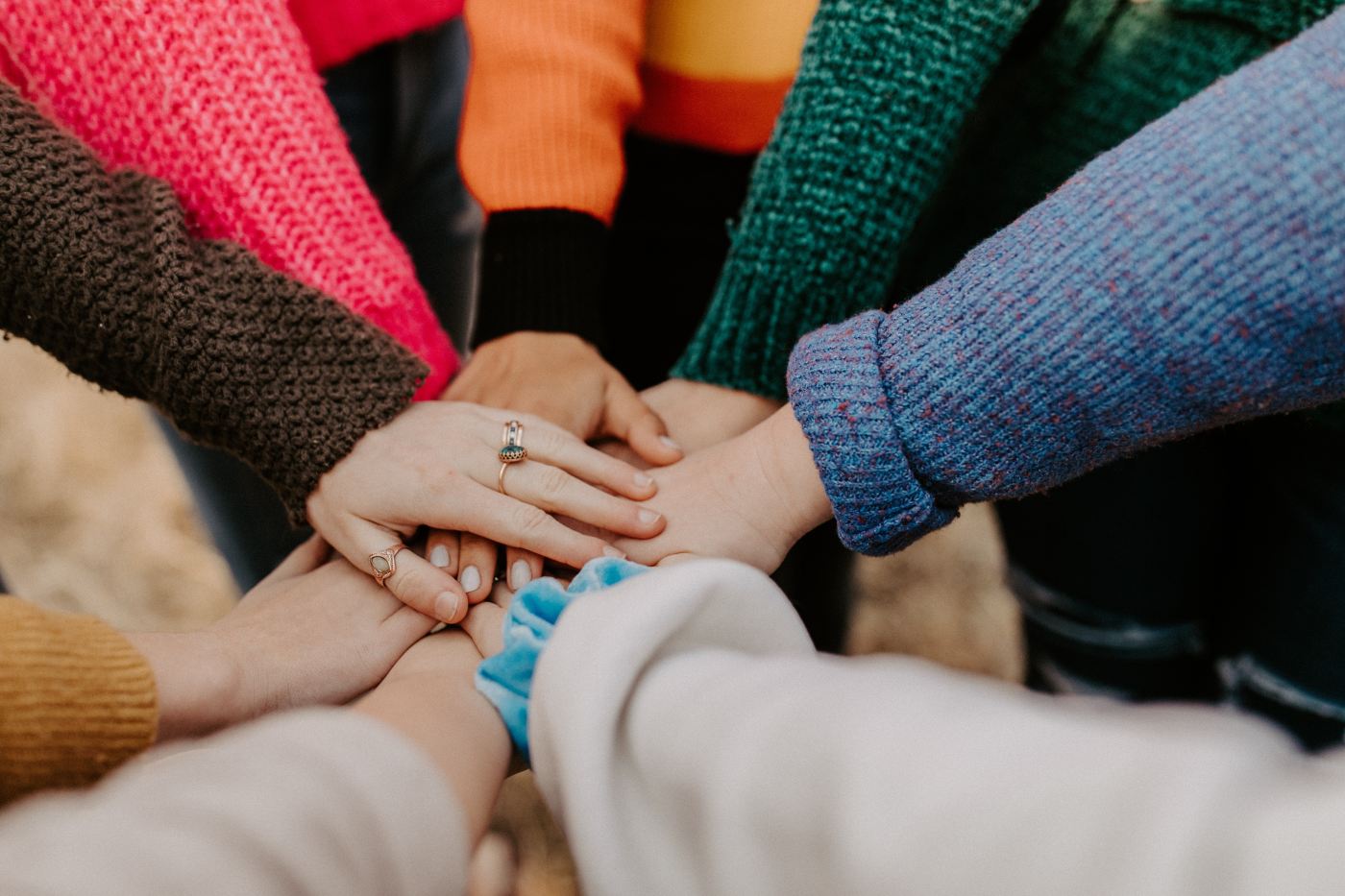
Whenever I chat with other unschooling parents, we almost always end up talking about community. It’s a peculiar paradox that one of the values that many unschooling families hold most dear can also be the most elusive. Of course, all human beings are hardwired to seek out community—social connection with others makes us feel safer and more fulfilled, helps us regulate our emotions and even improves our immune systems. When we are disconnected from others and feel isolated, we are more prone to anxiety and depression, and our physical health can suffer. It’s also patently obvious to any parent that parenting was never meant to be done in isolation. Even though it is very much the norm now, we all know that makes no sense at all.
Parents often turn to unschooling as a way to live more coherently with their children, in a space that values cooperation, consent, and diversity. At its heart is really the idea of a healthy community—different people living together as full individuals whilst respecting and honouring each other’s differences and boundaries. And yet, choosing not to go to school sometimes means rejecting the only community the family is part of.
In the context of a society in which community has generally been devalued, school offers a ready-made community. Even when things aren’t going well, it’s natural for there to be some sense of belonging and of common, shared experience. Many parents are not prepared for the sense of loss that can hit them when they leave that community. What felt like a fabulous decision at the start of summer can often feel quite different in September as the days get shorter, and the parks empty of children. Alongside the relief of leaving whatever the struggles were, there can be a real sense of loss. I vividly remember our first September day at home, many years ago. We lived in Spain at the time, and our house was just a block from the school that my sons had been attending. Despite it being our conscious choice to leave, I felt my heart lurch at the sound of parents and children passing by on their first day back to school. It didn’t make me feel excited by our newfound freedom. It just made me feel alone.
It’s a brave thing to follow a path that requires you stepping away from community. As I found out, there is likely to be an awkward transition period as you figure out who and where your new community is. However, the beautiful thing is that from this unsettling space you can start to create something that feels far more coherent and aligned. You have the chance to feel into what you need and to build something intentional for you and your children.
I admit that my mind still often wanders to a romanticised dream community. This is a cheery, like minded group of people living the good life somewhere beautiful (I am part of a fledgling cohousing group, so I am keeping that dream alive). However, aside from reluctantly acknowledging that nothing is perfect, I’ve also learned that the first step toward anything is to get happy with what we have. This has led to me realise that my own community is a rich and eclectic mix of all sorts of people who make my life feel pleasant and connected. From friendly neighbours and shopkeepers to my much-loved sea-swimming and running buddies, as well as close friends who unschool and with whom there is a depth of understanding that arises from common experience. There are some friends with children who we enjoy spending time with and who are always up for an adventure, and there is the wider home education community, that we dip in and out of. There are other friends, near and far, and there are the many people in the unschooling world who I only get to connect with online, but with whom the conversations are always inspiring.
Within all the above, I value the parts of my community that only I connect with as much as I value the parts that my children are directly a part of too. Partly, because it all makes me feel safe and happy, but also because I believe that how we experience the world around us directly impacts our children.
And, how should community look for our children? Alongside the feelings of loneliness when we lack community, there can also be a deep sense of guilt that we have not managed to replace school with something just as big and important. And, if our child enjoys spending lots of time with their peers, this might be a difficult transition for them too. However, this is also an opportunity to talk to our children about what they would like. There’s a widely-held assumption that all children want to be with other children all day, and whilst that may be true for some children, it certainly isn’t the case for all. I have friends whose children live for the next play date, and friends whose children prefer a limited amount of social interaction with close friends. Working out what feels right for your children is the best starting point.
In our home, social needs vary widely, and change over time and by season. There have been periods where a usually sociable person feels like nesting for a while, and times where a more introverted person has been unusually busy. One of the big advantages of community beyond school is that it is flexible and can shift as our children grow and change. If we are creating the connections and tending them, we are also holding a safe structure that our children can enter and leave as feels right to them. I’ve noticed that there are moments where I feel like all our needs are being met, then some kind of shift happens (friendships change, people move away, groups end…) and I sense the need to invest some energy again.
So, accept that creating your community may well be a slow and organic process that will shift and change over time. It is likely to take quite a lot of effort and a number of false starts. But, keep in mind that everything is a learning experience. Rather than feel down about what you feel might be missing, show your children what matters to you and how you can bring it into your lives.
Some tips for building your community
1) Don’t beat yourself up or feel guilty if you are feeling isolated. Treat the feelings as exactly what they are —simply an indication that there are needs that aren’t being met.
2) Consider how you can meet your needs and your children’s needs, whilst understanding that these might be very different. When some people in the family are more extroverted than others, this can be quite a feat and require some creativity. Let go of how other people think things “should” look like and think instead about how you thrive as individuals. Creating something that is right for all of you isn’t necessarily simple, but it’s a wonderful opportunity to acknowledge your different needs and to work together.
3) Try things out and meet new people. Head along to things that are going on locally even if you’re not sure it will be a good fit. You never know who or what’s out there if you don’t give it a go.
4) If something feels like a wonderful opportunity for your family, but your children are reluctant, it can be a good idea to try it out without them. Over the years, I’ve been to a number of groups and events without my children. Eventually, if I felt connected to the people, my children would come along too.
5) See if you can build something yourself. It could just be an open invitation on a local home ed board to meet in a park, or perhaps you or your child has a special interest and you’d like to create a group around it. My experience of this is that sometimes nothing comes of it and other times you make fantastic new connections. If you feel a bit reluctant about taking the leap by yourself maybe wait til you’ve made a couple of like minded connections then see if you can do something together.
6) Invest time in getting to know the people around you, and don’t assume that the people you need in your lives need to look just like you. The more varied your community, the richer the experience. A huge benefit of community beyond school is that children get to hang out with adults and children of all ages. One of my children, in particular, has always felt uncomfortable in peer groups but thrives in mixed-age groups. In fact, they were telling me the other day that they think that mixed-age groups often bring out the best in people, and I think that could well be true.
7) If you can’t find people locally that really understand what you’re doing, having some like minded souls online can be extremely comforting. This could be through a Facebook group or with an online unschooling community. A place to share worries and to gain new perspectives can be a real lifesaver, particularly in the beginning, when there are likely to be a lot of doubts.
8) Don’t compare with school—success isn’t finding 20 peers for your child to hang out with all day. Success is continually looking to create something that feels good and healthy for you all. And that is likely to look very different from school.

 A PLACE ON A HILL